
Industry Overview
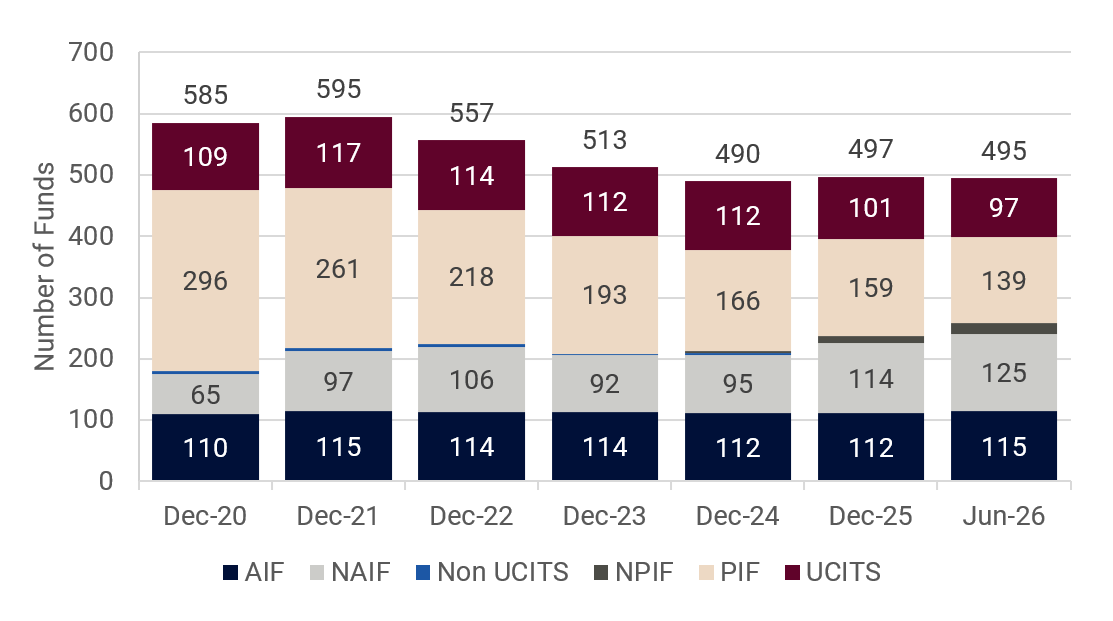
The number of Malta-domiciled funds stood at 495 at end-June 2026, down marginally from 497 at end-2025. During the first half of the year, 31 funds were licensed or notified, while 33 were surrendered or de-notified.
Although the overall number of funds remained largely unchanged, the industry continued to shift towards notified structures. NAIFs increased from 114 to 125, making them the second-largest category, while NPIFs rose by eight to 19, reflecting a sustained preference for faster and more flexible regulatory frameworks. AIFs also edged up by three to 115. By contrast, the number of PIFs declined by 20 to 139, while UCITS decreased by four to 97. Nonetheless, PIFs remained the largest segment, accounting for 28.1% of all Malta-domiciled funds.
Figure 1: Number of Funds (incl. sub-funds) (Dec-2020 – Jun-2026)
Fund Assets Reach New Highs
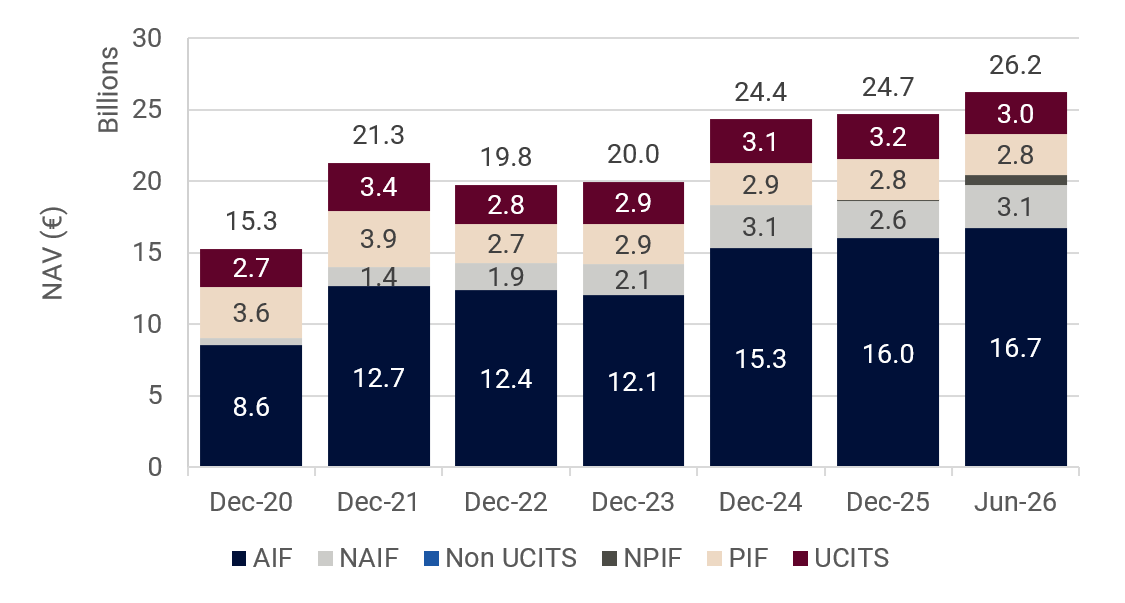
Total net asset value (NAV) rose to €26.2 billion at the end of June 2026, up 6.2% (€1.5 billion) compared with end-2025 and 10.4% (€2.5 billion) year-on-year. This growth was driven primarily by net inflows of €1.3 billion in the first half of the year, more than double the €523.5 million recorded in the corresponding period of 2025, as well as positive net revaluation adjustments of €0.4 billion.
Inflows were concentrated in notified structures and AIFs, with NPIFs, NAIFs and AIFs attracting €0.5 billion, €0.4 billion and €0.3 billion respectively, while PIFs recorded comparatively modest inflows. UCITS was the only structure to record net outflows, amounting to €0.1 billion.
In NAV terms, NPIFs recorded substantial growth, increasing from €57.5 million in December 2025 to €654.8 million in June 2026. NAIFs and AIFs also expanded, by 15.9% and 4.4% respectively, while PIFs remained broadly stable, growing by just 0.2%. Unlike all other fund structures, UCITS recorded a decline in NAV of 6.2%.
AIFs continued to dominate the sector, accounting for 63.7% of total NAV (€16.7 billion). In addition, NAIFs surpassed UCITS as the second-largest fund category by NAV share, representing 11.6% and 11.3% of total NAV respectively.
Figure 2: Total NAV by Type of Fund (Dec-2020 – Jun-2026)
Investment Trends
Equity and diversified funds remained the largest fund classes, representing 39.1% and 22.3% of total NAV respectively. Bond funds accounted for a smaller share of 10.9%, followed by funds investing in virtual financial assets (10.6%).
A Strong Domestic Ecosystem
Malta continued to maintain a strong domestic ecosystem, with 86.2% of all funds, representing 87.4% of total NAV, managed locally, either by Malta-based fund managers (52.1%) or on a self-managed basis (34.1%).
Furthermore, 91.6% of funds, representing 78.1% of NAV, were administered in Malta, highlighting the jurisdiction’s ability to provide a comprehensive range of fund services.
The European and International Funds Industry
The European fund industry also expanded during the first half of 2026. Total net assets rose by 9.0% compared with end-2025 to reach €27.5 trillion, with UCITS and AIFs increasing by 10.7% and 5.7% respectively.
Net inflows amounted to €548.9 billion, led by bond and equity funds, which attracted €163 billion and €135.8 billion respectively. All fund categories recorded net inflows during the period, with real estate funds recording a turnaround from net outflows of €11.2 billion in 2025 to net inflows of €2.7 billion in the first half of 2026.
Globally, the fund industry also continued to grow, with net assets of regulated open-ended funds increasing by 11.6% in euro terms to reach €89.7 trillion, accompanied by net inflows of €1.7 trillion. Bond funds remained the top-selling asset class with net inflows of €804.3 billion, followed by money market funds (€343.4 billion) and equity funds (€303.7 billion).
Key Takeaways
Malta’s fund industry recorded a marginal decline in the number of licensed funds in the first half of 2026, while aggregate NAV grew by 6.2%, supported primarily by AIFs, NAIFs and NPIFs. Net inflows more than doubled compared with the same period of 2025, driven mainly by notified structures and AIFs, while the continued decline in PIFs and UCITS points to an ongoing shift in the composition of the sector.
Although NAV growth in Malta remained below the rates recorded at the European (9.0%) and global (11.6%) levels, the sector continued to demonstrate resilience and adaptability in a changing market environment. The continued expansion of notified structures, coupled with strong asset growth and sustained local servicing capacity, highlights the industry's ongoing evolution and its ability to respond to changing investor and market preferences.
For a more detailed analysis of these trends, refer to the MFSA publication: Key Indicators on the Maltese and International Fund Industries (June 2026).
