How to Verify an Email from the MFSA
The Malta Financial Services Authority (MFSA) uses S/MIME digital signatures for outgoing email communications. This additional security measure can help recipients confirm that an email was sent from an authorised MFSA email identity and that its signed content has not been altered after the message was issued.
Digital signatures are an additional security measure. They do not replace normal email-security precautions.
How Can Recipients Recognise a Digitally Signed MFSA Email?
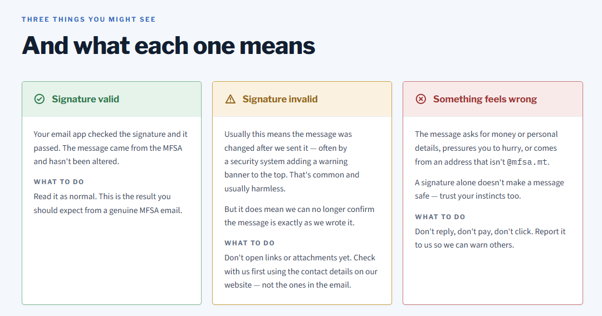
Depending on the email application being used, a digitally signed message may display a certificate, ribbon, shield, or signature icon. When the signature is successfully validated by the recipient’s email system, it provides assurance that:

- The message was sent using an MFSA identity associated with a trusted digital certificate;
- The signed content has not been altered since the email was digitally signed;
- The sender’s identity can be cryptographically verified by compatible email systems.
For most recipients using compatible email applications, including Microsoft Outlook, no action is required.
What If the Digital Signature is Reported as Invalid?
A digital signature may occasionally appear as invalid if the email is modified after being signed. For example, some organisations automatically insert an “External Email”, “Warning” or similar security banner into incoming messages. This changes the signed content and may prevent the recipient’s email application from validating the original signature.
An invalid signature does not, by itself, confirm that an email is fraudulent. However, it means that the authenticity and integrity of the signed message can no longer be conclusively validated. Recipients should therefore exercise caution and verify the communication through their usual MFSA contact before acting on the message, opening attachments, or selecting links.
Remain Vigilant
A valid digital signature provides additional assurance regarding the sender’s identity and the integrity of the signed content. Recipients should nevertheless continue to follow their organisation’s established email-security procedures and remain alert to unusual or unexpected requests.
If there is any uncertainty regarding an email claiming to originate from the MFSA, recipients should verify the communication using a known MFSA contact or an official contact channel.
The introduction of digitally signed emails represents another important step in strengthening the security, authenticity, and reliability of the MFSA’s external communications.