
1.2 – Supervising Finance in a Fragmented World: Geopolitical Risk and the Quest for Regulatory Resilience
Abstract
The growing fragmentation of the global order driven by sanctions regimes, trade realignments, and strategic competition has reshaped the landscape of financial supervision. This paper examines how geopolitical risk permeates supervisory practice through channels such as market volatility, supply-chain reconfiguration, and data-sovereignty constraints. Drawing on international reports and supervisory statements, it analyses how regulators are adapting stress-testing frameworks, risk taxonomies, and cross-border cooperation mechanisms to reflect geopolitical exposures. The paper argues that geopolitical fragmentation constitutes a structural transformation rather than a contextual shock, requiring a shift from rule-based supervision toward adaptive, resilience-oriented governance. It conceptualises this shift through the notion of regulatory resilience – the capacity of supervisory authorities to anticipate, absorb, and adapt to risks originating beyond the financial system. By mapping emerging supervisory responses across jurisdictions, the paper offers a comparative framework for integrating geopolitical risk into prudential and conduct supervision, while highlighting the need to balance resilience with proportionality and regulatory simplicity.
Keywords: global fragmentation, geopolitical risk, regulatory resilience.
Information
| Type | Global Fragmentation, Geopolitical Risk, Regulatory Resilience – the work of George Vital Zammit |
| Information | Journal of Financial Supervisors Academy, Volume 2, November 2026, pp. 33-49 |
| Creative Commons |   CC BY 4.0 This is an open access article under the CC BY license. Journal of Financial Supervisors Academy © 2026. Licensed under CC BY 4.0. |
| Copyright | © The Author, 2026. Published by Journal of Financial Supervisors Academy |
Introduction
The global financial landscape is transitioning from a period of deep integration toward a regime characterised by ‘strategic autonomy’ across major regional blocs.1 This shift is underscored by a reorientation of trade and financial linkages,2 moving away from multilateral efficiency toward infrastructures shaped by national security considerations and political alignment.3 This shift toward “just-in-case” (contingent) economic strategies, encompassing nearshoring and friendshoring is replacing traditional models with supply chains fortified against geopolitical volatility.4 These systemic recalibrations, driven by heightened competition and the resulting fragmentation of globalised economies, exacerbate banking vulnerabilities and diminish the efficacy of traditional risk diversification strategies.5 Consequently, the increasing unpredictability of cross-border economic policies, compounded by tensions surrounding critical resources and trade,6 necessitates that supervisory authorities account for the systemic risks inherent in this era of deglobalisation.7 However, current international regulatory frameworks remain largely tethered to the now-fragmenting model of financial globalisation, suggesting that uniform global standards will likely prove insufficient to address these localised geopolitical pressures.8
This paper makes three contributions. First, it brings together the emerging literature on geopolitical risk and financial supervision, fields that have largely developed in parallel. Second, it develops the concept of regulatory resilience as an analytical framework for understanding supervisory adaptation under conditions of geopolitical fragmentation. Third, by analysing recent reports issued by leading supervisory institutions, it identifies common patterns of supervisory evolution and proposes a structured framework for integrating geopolitical risk into prudential supervision.
This paper proceeds as follows. The next section reviews the existing literature on geopolitical risk and financial supervision, identifying key gaps in the current prudential and macroprudential frameworks. A theoretical framework grounded in resilience theory and adaptive governance is then proposed, providing an analytical lens through which supervisory responses to geopolitical risk can be systematically assessed. The work employs qualitative document analysis of selected supervisory and policy reports issued by leading international financial institutions. The analysis is organised around a theoretical framework of regulatory resilience, through which contemporary supervisory responses to geopolitical risk are examined and compared. The subsequent sections present the results of the analysis, focusing on the transmission channels through which geopolitical risk affects financial systems and supervisory practice. The discussion then interprets these findings in light of emerging regulatory challenges, proposing adaptive supervisory responses and policy considerations. The paper concludes by synthesising the main insights and outlining implications for the development of resilient, forward-looking supervisory frameworks in an increasingly fragmented global financial environment.
Literature Review
The growing intersection between geopolitical risk and financial stability has generated a rapidly expanding body of interdisciplinary scholarship. This literature spans macroeconomics, banking regulation, and political economy, converging on the recognition that geopolitical developments, once treated as exogenous shocks, are increasingly embedded within the structural dynamics of financial systems. This section synthesises the key strands of this literature, focusing on three core themes: (i) the relationship between geopolitical risk and financial stability, (ii) the limitations of existing prudential frameworks, and (iii) emerging supervisory and regulatory responses. For the purposes of this paper, regulatory resilience is treated as the principal analytical concept through which supervisory adaptation to geopolitical fragmentation is examined.
Geopolitical Risk and Financial Stability
A central insight emerging from recent empirical studies is that geopolitical risk has a measurable and often destabilising impact on financial systems. Elevated geopolitical tensions have been shown to increase systemic risk by amplifying individual bank vulnerabilities, triggering asset price volatility, and intensifying cross-market spillovers.9 These dynamics are further compounded by economic policy uncertainty, which interacts with geopolitical instability to erode bank profitability and weaken capital positions.10 The literature highlights the transformation of global financial interdependence – whereas cross-border integration was previously associated with risk diversification, recent evidence suggests that it now facilitates the rapid transmission of geopolitical shocks across geographically dispersed portfolios.11 This shift reflects the increasing synchronisation of financial cycles and the deep interconnectedness of banking systems, particularly within advanced economies.12
At the macro level, geopolitical tensions have been linked to rising sovereign risk, increased borrowing costs, and heightened volatility in bond and foreign exchange markets.13 These effects are especially pronounced in emerging markets, where institutional fragility and limited policy space exacerbate exposure to external shocks.14 At the same time, geopolitical developments in strategic sectors such as energy and critical raw materials, generate spillover effects that propagate through financial markets, reinforcing systemic instability.15 These studies lead the argument that geopolitical risk is not merely episodic but a persistent driver of financial instability, requiring closer integration into supervisory analysis.
Limitations of Existing Prudential Frameworks
Despite the growing recognition of geopolitical risk, existing regulatory frameworks remain largely anchored in models developed for a more stable global environment. The Basel III framework,16 while effective in strengthening capital and liquidity buffers, has been criticised for its limited capacity to capture non-linear and exogenous shocks.17 In particular, standardised risk-weighting approaches are ill-suited to capturing the heterogeneous and evolving exposure of financial institutions to geopolitical risk. Macroprudential policies face similar constraints. Although designed to address systemic risk, they often rely on indicators derived from financial and macroeconomic variables, with limited incorporation of political or strategic factors. As a result, they may underestimate the impact of sudden geopolitical disruptions or fail to anticipate second-order effects, such as panic-driven market behaviour or the breakdown of cross-border cooperation.18
The challenges are particularly acute in the context of geoeconomic fragmentation. As global financial integration gives way to regionalisation and strategic decoupling, supervisory frameworks based on harmonised international standards encounter increasing friction. Divergences in regulatory regimes, data governance, and enforcement priorities complicate cross-border supervision and reduce the effectiveness of coordinated policy responses.19 Moreover, the emergence of alternative financial infrastructures such as regional payment systems and digital financial networks raises new questions about the scope and reach of regulatory oversight.20 These developments suggest that the traditional model of globally coordinated supervision may need to be complemented by more flexible, context-specific approaches.
Emerging Supervisory and Regulatory Responses
In response to these challenges, recent literature has begun to explore new approaches to integrating geopolitical risk into financial supervision. One prominent strand emphasises the role of enhanced risk measurement and early warning systems. The incorporation of geopolitical risk indices and uncertainty measures into macroprudential analysis has been shown to improve the identification of systemic vulnerabilities,21 particularly for institutions with significant cross-border exposure.22 Another area of innovation concerns the use of advanced analytical tools, including machine learning and high-frequency data analysis, to detect emerging patterns of volatility and contagion.23 These tools enable supervisors to move beyond static risk assessments toward more dynamic and forward-looking approaches. Scenario-based stress testing has gained prominence as a means of evaluating the resilience of financial institutions under extreme but plausible geopolitical conditions.24
The literature also highlights the importance of proportionality and regional adaptation in regulatory design. Given the heterogeneous impact of geopolitical risk across jurisdictions, there is growing support for tailoring supervisory frameworks to local conditions, while maintaining alignment with broader international standards.25 This approach is especially relevant for smaller or open economies, where exposure to external shocks is significant but supervisory resources may be limited.
Institutional innovation represents a further dimension of emerging responses. Proposals for interinstitutional intelligence units and enhanced public-private cooperation reflect the recognition that geopolitical risk cannot be effectively managed within traditional regulatory silos.26 Similarly, calls for improved international coordination underscore the need to reconcile national policy objectives with the collective goal of financial stability, even in an increasingly fragmented global environment.27 Finally, the literature emphasises the role of governance quality and institutional capacity as critical factors in mitigating the impact of geopolitical shocks. Strong governance frameworks, effective enforcement mechanisms, and robust financial infrastructures are consistently associated with greater resilience to external disruptions.28
Synthesis and Research Gap
While the existing literature provides valuable insights into the relationship between geopolitical risk and financial stability, several gaps remain. First, much of the empirical work focuses on the impact of geopolitical risk on financial outcomes, with less attention to how supervisory systems themselves should adapt. Second, there is limited integration between macro-level analyses of geoeconomic fragmentation and micro-level considerations of supervisory practice. The objective of this paper is to address these gaps by shifting the focus from risk impact to regulatory response. Specifically, it seeks to develop a conceptual framework for understanding how supervisory authorities can incorporate geopolitical risk into their operational and strategic functions. By linking empirical findings to the concept of regulatory resilience, the analysis contributes to a more integrated understanding of financial supervision in a fragmented global context. These limitations point to the need for a more adaptive theoretical framework, which is proposed in the following section.
Theoretical Framework: Regulatory Resilience and Adaptive Supervision
The growing centrality of geopolitical risk in financial systems challenges the conceptual foundations upon which modern financial supervision has been constructed. Traditionally, supervisory frameworks have been designed to address endogenous risks arising within financial markets, such as credit cycles, liquidity mismatches, and institutional failures – under the implicit assumption of a relatively stable and cooperative international order. However, as geopolitical fragmentation increasingly shapes economic outcomes, this assumption no longer holds. Supervisory authorities are now required to operate in an environment characterised by persistent uncertainty, strategic competition, and the politicisation of economic relations. In this context, existing regulatory paradigms must be complemented by theoretical approaches capable of addressing systemic uncertainty beyond the financial domain.
The concept of regulatory resilience builds upon broader scholarship on responsive regulation while extending it to a new category of systemic risk. Effective regulation requires regulators to adapt their interventions to the conduct, behaviour, and risk profile of regulated entities rather than relying exclusively on prescriptive rules.29 Subsequent work in financial regulation has similarly emphasised the importance of supervisory flexibility, proportionality, and risk-sensitive oversight in environments characterised by uncertainty and complexity.30 Viewed through this lens, regulatory resilience may be understood as an extension of responsive regulation to the domain of geopolitical risk, where supervisors must continuously adjust their analytical frameworks, supervisory priorities, and regulatory tools in response to evolving external threats.
This work adopts a combined framework of resilience theory and adaptive governance to conceptualise how supervisory systems can respond to geopolitical risk. Together, these perspectives provide the analytical foundation for what is termed here regulatory resilience: the capacity of supervisory institutions to anticipate,31 absorb,32 and adapt to exogenous shocks while maintaining core financial stability objectives.33
Resilience Theory and Financial Supervision
Resilience theory conceptualises systems not as static equilibria but as dynamic structures capable of absorbing disturbances and reorganising in response to change. In contrast to traditional models that prioritise efficiency and optimisation, resilience emphasises robustness, redundancy, and adaptability as key system properties. Over time, this perspective has been extended to infrastructure systems, public policy, and, more recently, financial regulation.34
In the context of financial supervision, resilience shifts the focus from preventing crises to ensuring that financial systems can withstand and recover from them. This distinction is particularly relevant in an era of geopolitical fragmentation, where shocks are not only more frequent but also less predictable and less amenable to conventional modelling techniques. As highlighted in the literature, geopolitical risks often manifest as non-linear and asymmetric shocks, producing cascading effects across interconnected financial networks. Traditional prudential tools, such as fixed capital buffers or risk measures based on past data, are not well suited to capturing these dynamics.
Regulatory resilience, by contrast, prioritises the capacity of institutions and regulatory frameworks to function under stress conditions. This involves not only maintaining adequate capital and liquidity levels but also ensuring operational continuity, diversified exposures, and institutional flexibility.35 Importantly, resilience does not imply resistance to change; rather, it encompasses the ability to adapt and transform in response to evolving risk environments. For supervisors, this entails moving beyond compliance-based approaches toward a more holistic understanding of systemic vulnerability.
Adaptive Governance Under Conditions of Uncertainty
While resilience theory provides a system-level perspective, adaptive governance offers an institutional framework for decision-making under conditions of uncertainty. Originating in public administration and environmental policy studies, adaptive governance emphasises iterative learning, decentralised problem-solving, and flexible rule-making in response to complex and evolving challenges.36 In contrast to hierarchical, rule-bound regulatory models, adaptive governance recognises that in highly uncertain environments, no single authority possesses complete information or predictive capacity. Instead, effective governance relies on continuous feedback loops, experimentation, and coordination across multiple actors. This approach is particularly relevant for financial supervision in a fragmented global system, where geopolitical developments can rapidly alter the operating environment in ways that cannot be fully anticipated. For supervisory authorities, adopting an adaptive governance framework implies several shifts.
First, it requires the integration of forward-looking risk assessment tools, such as scenario analysis and horizon scanning, to complement traditional backward-looking indicators. Second, it necessitates enhanced institutional coordination, both domestically and internationally, to share information and align responses in the face of cross-border risks. Third, it involves a degree of regulatory flexibility, allowing supervisors to adjust rules and supervisory intensity in response to emerging threats without undermining legal certainty or market confidence.
Importantly, adaptive governance also highlights the role of learning institutions. Supervisory bodies must develop the capacity to incorporate new information,37 revise assumptions, and update regulatory practices in an ongoing manner.38 In the context of geopolitical risk, this may involve integrating insights from non-financial domains such as political analysis, security studies, and technological risk assessment into supervisory decision-making processes.39
Towards a Concept of Regulatory Resilience
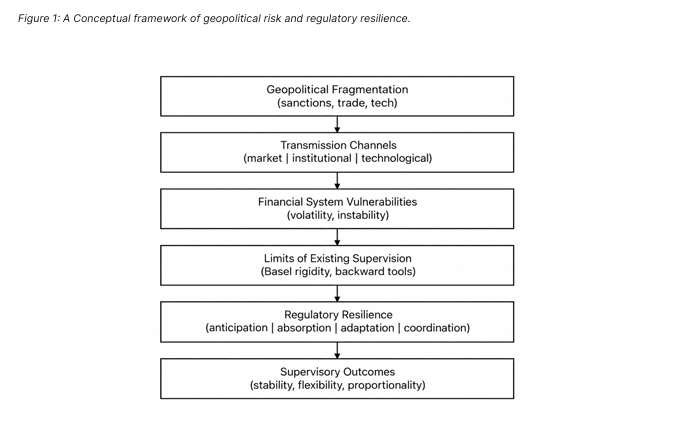
Building on these two theoretical strands, this paper conceptualises regulatory resilience as a multi-dimensional property of supervisory systems. Regulatory resilience refers not only to the robustness of individual financial institutions but also to the capacity of the supervisory architecture itself to operate effectively under conditions of geopolitical stress. This concept can be operationalised along four interrelated dimensions: (1) Anticipation, (2) Absorption, (3) Adaptation and (4) Coordination.
i. Anticipation
Supervisors must develop the ability to identify early signals of geopolitical risk and assess their potential impact on financial systems. This includes the use of geopolitical risk indices, scenario-based stress testing, and qualitative intelligence gathering. Anticipation is closely linked to the notion of horizon scanning, where emerging risks are systematically monitored even in the absence of immediate financial indicators.
ii. Absorption
The financial system’s capacity to absorb shocks without systemic breakdown remains a core objective of prudential regulation. In a geopolitical context, this involves ensuring that banks and financial institutions maintain sufficient capital and liquidity buffers, diversified asset portfolios, and robust risk management practices to withstand external disruptions.
iii. Adaptation
Adaptation refers to the ability of supervisory frameworks to adjust in response to changing conditions. This may involve recalibrating capital requirements, revising supervisory priorities, or introducing new regulatory tools tailored to specific geopolitical exposures. Adaptation requires institutional flexibility and the capacity to implement changes in a timely manner.
iv. Coordination
Given the cross-border nature of geopolitical risk, effective supervision depends on coordination among national and international authorities. However, fragmentation complicates this process, as geopolitical tensions may limit information sharing and regulatory alignment. Regulatory resilience therefore entails developing mechanisms for cooperation that can function even in politically constrained environments.
Together, these dimensions provide a structured framework for analysing how supervisory systems respond to geopolitical risk. They also highlight the inherent tension between national strategic autonomy and global financial integration, a theme that this paper aims to unpack.
Implications for Supervisory Practice
Applying the concept of regulatory resilience to financial supervision reveals several important implications. First, it suggests that supervisors must expand their analytical scope beyond traditional financial metrics to include geopolitical variables as integral components of systemic risk assessment. This requires interdisciplinary approaches that bridge finance, economics, and political analysis.40
Second, it underscores the importance of dynamic regulatory tools. Static frameworks, while effective in stable environments, are insufficient in the face of rapidly evolving geopolitical risks. Supervisors must therefore adopt tools that allow for continuous adjustment, such as scenario-based stress testing and real-time monitoring systems.
Third, the framework highlights the need to balance complexity and simplicity in regulatory design. While incorporating geopolitical risk inevitably increases analytical complexity, excessive regulatory burden can undermine efficiency and compliance. Regulatory resilience thus involves identifying proportionate responses that enhance stability without overburdening institutions. Finally, the framework points to the growing significance of institutional capacity. Supervisory authorities must invest in expertise, data infrastructure, and international partnerships to effectively manage geopolitical risk. For smaller jurisdictions, this may involve leveraging cooperative networks to access resources and knowledge that would otherwise be beyond their reach. The below figure illustrates the conceptual framework of the study, linking geopolitical fragmentation to financial system vulnerabilities through multiple transmission channels, and highlighting the role of regulatory resilience as an adaptive supervisory response.
Research Design and Data Sources
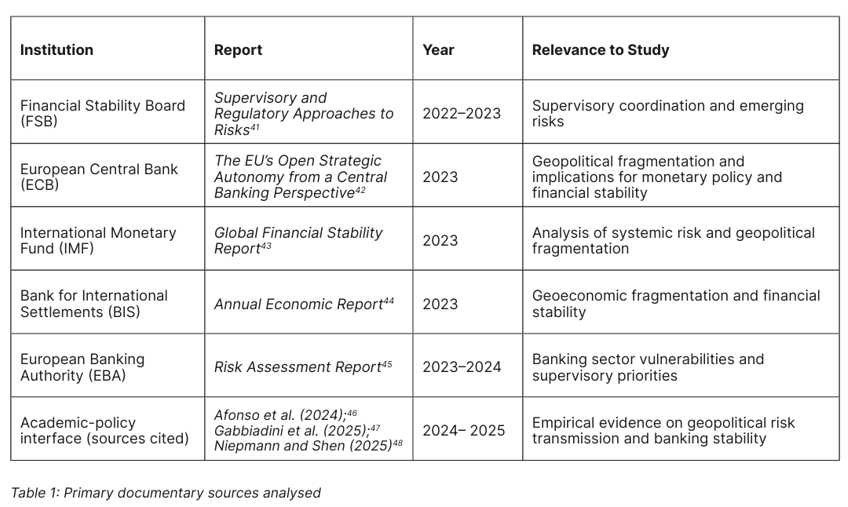
This study adopts a qualitative content analysis using desktop research which is based on the systematic analysis of secondary sources, including academic literature, policy reports, and supervisory publications. The empirical component of the analysis focuses on a selected set of reports issued by key international financial institutions and regulatory bodies, as summarised in Table 1. These include publications from the International Monetary Fund (IMF), the Bank for International Settlements (BIS), the European Central Bank (ECB), the Financial Stability Board (FSB), and the European Banking Authority (EBA).
These sources were selected based on three criteria: (i) institutional authority in global financial supervision, (ii) recency and relevance to emerging geopolitical risks, and (iii) explicit engagement with systemic risk, financial stability, or supervisory policy. In addition, the selection reflects the prominence of these institutions in shaping global supervisory discourse and their direct involvement in macroprudential oversight and policy coordination. Together, they provide a representative cross-section of contemporary supervisory thinking at both global and European levels. The analysis combines thematic synthesis with comparative interpretation. First, recurring patterns in the literature and policy reports are identified, particularly concerning the transmission channels of geopolitical risk: market, institutional, and technological, and their impact on financial stability. Second, these patterns are interpreted through the analytical lens of regulatory resilience, focusing on how supervisory authorities anticipate, absorb, adapt to, and coordinate responses to geopolitical shocks.
The study does not seek to establish causal relationships, but rather to provide a structured and conceptually informed interpretation of how geopolitical risk is currently understood and operationalised within supervisory practice. As such, the findings should be understood as analytical insights intended to inform the development of more adaptive and resilient supervisory frameworks.
Results
Drawing on the comparative analysis of the policy and supervisory sources outlined in Table 1, the findings are organised around the key dimensions of regulatory resilience: anticipation, absorption, adaptation, and coordination – identified in the theoretical framework. The analysis identifies a set of consistent patterns regarding the interaction between geopolitical risk and financial stability, as well as the implications for supervisory practice. Four main observations emerge.
Geopolitical risk as a driver of systemic instability. Elevated geopolitical tensions are associated with increased systemic risk across banking systems. This occurs through multiple channels, including heightened asset price volatility, rising sovereign risk, and increased funding costs. Empirical studies consistently show that geopolitical uncertainty amplifies bank-level vulnerabilities,49 particularly by eroding profitability and weakening capital positions.50 In addition, geopolitical shocks generate non-linear effects, including second-order panic dynamics that are not captured by conventional risk models.51 These dynamics can accelerate contagion across financial markets, particularly in highly interconnected systems.
Heterogeneous institutional vulnerabilities. The impact of geopolitical risk is not uniform across jurisdictions or institutions. Banks with high cross-border exposure, limited liquidity buffers, or reliance on volatile funding sources are disproportionately affected. Institutions operating in emerging or conflict-affected regions exhibit heightened sensitivity to geopolitical shocks, often responding by reducing lending activity and retrenching from international markets.52 Conversely, strong governance frameworks, robust regulatory environments, and diversified asset structures are associated with greater resilience.53 This suggests that institutional capacity plays a critical moderating role in shaping the transmission of geopolitical risk.
Limitations of existing supervisory frameworks. The analysis further indicates that existing prudential and macroprudential frameworks struggle to fully capture the complexity of geopolitical risk. Standard models, including Basel III-based approaches, are primarily designed for financial and economic shocks and therefore lack sensitivity to political and strategic disruptions. A key limitation of traditional stress-testing methodologies is their insufficient integration of forward-looking geopolitical scenarios, which constrains their effectiveness in anticipating systemic vulnerabilities.54 This gap is compounded by challenges related to information asymmetry and the difficulty of quantifying non-financial risks.
Emerging supervisory adaptations. The reports reviewed reveal a gradual shift toward more adaptive supervisory practices. The ECB emphasises the need to incorporate geopolitical fragmentation into central bank risk assessment and supervisory planning,55 while the IMF highlights the growing importance of scenario-based analysis for assessing financial vulnerabilities arising from geopolitical tensions.56 Similarly, the BIS stresses the need for forward-looking approaches capable of addressing geoeconomic fragmentation,57 and the EBA identifies geopolitical developments as a growing source of banking sector vulnerability.58 Together, these reports point toward greater use of geopolitical risk indicators, scenario analysis, and early warning mechanisms within supervisory practice.
Discussion
The analysis of the selected reports reveals both incremental adaptation and persistent structural gaps in current supervisory frameworks. The results underscore the importance of anticipation as a core dimension of supervisory resilience. While the incorporation of geopolitical risk indices and scenario-based stress testing represents a significant step forward, current practices remain largely reactive. Supervisory frameworks continue to rely heavily on backward-looking indicators, limiting their ability to detect emerging geopolitical threats before they materialise as financial instability. Strengthening horizon-scanning capabilities and integrating qualitative geopolitical intelligence into risk assessment processes therefore remain critical priorities.59 60
The evidence also points to the uneven capacity of financial systems to absorb shocks, reflecting differences in institutional strength and governance quality. Banks operating in jurisdictions with robust regulatory frameworks and diversified exposures demonstrate greater resilience, while those in more fragile environments are disproportionately affected by geopolitical volatility. This reinforces the need for proportionate supervisory approaches that account for heterogeneous risk profiles.
The reports also highlight the growing importance of adaptation in supervisory practice. The shift toward dynamic, risk-sensitive capital frameworks and scenario-based analysis reflects an emerging recognition that static regulatory models are insufficient in a fragmented global environment. However, the pace of adaptation remains uneven, and in many cases constrained by legal, institutional, and political factors. The results illustrate the central role of coordination, particularly in managing cross-border risks. While macroprudential cooperation is widely recognised as essential, geopolitical fragmentation complicates information sharing and policy alignment. This creates a structural tension between the need for international cooperation and the pursuit of national strategic autonomy.61 62 63
These dynamics suggest that regulatory resilience is not simply a function of stronger rules, but of more adaptive and context-sensitive supervisory systems. The challenge for policymakers is therefore to design frameworks that balance robustness with flexibility, and coordination with sovereignty. This also has implications for the ongoing agenda of simplification and burden reduction. While the integration of geopolitical risk inevitably increases analytical complexity, excessive regulatory layering may undermine effectiveness. A resilience-oriented approach thus requires identifying targeted interventions that enhance systemic stability without imposing unnecessary compliance burdens.64 65
More broadly, the findings suggest that geopolitical fragmentation challenges one of the implicit assumptions underpinning post-crisis financial regulation: namely, that systemic risk is primarily generated within financial markets themselves. Instead, supervisory authorities increasingly confront risks originating outside the financial system, requiring broader institutional capabilities and closer interaction between financial supervision, economic policy and geopolitical analysis. Ultimately, these reports indicate that geopolitical risk is reshaping not only financial markets but also the very foundations of financial supervision. Addressing this challenge requires a shift from static, rule-based models toward a more dynamic paradigm of regulatory resilience.
The study is also subject to several limitations. It relies on qualitative analysis of institutional reports rather than primary empirical data and therefore does not assess the effectiveness of supervisory responses in practice. Future research could examine whether supervisory authorities that more explicitly integrate geopolitical risk into prudential frameworks exhibit greater resilience during episodes of financial fragmentation.
Conclusion
The paper argued that geopolitical fragmentation is not merely a contextual factor but a structural transformation that requires a shift from rule-based supervision to adaptive, resilience-oriented governance. By looking at a selection of reports, it examined how geopolitical risk is reshaping the landscape of financial supervision, arguing that traditional regulatory frameworks, largely designed for economically driven shocks, are increasingly insufficient in a fragmented and politically contingent global environment. The analysis demonstrated that geopolitical risk has become a systemic and persistent driver of financial instability, affecting banking systems through multiple transmission channels, including market volatility, sovereign risk dynamics, and disruptions to cross-border financial integration.
The studies under the spotlight highlighted both progress and limitations in current supervisory practice. While there is growing evidence of innovation, particularly in the use of scenario-based stress testing, geopolitical risk indicators, and early warning systems, these efforts remain uneven and often constrained by institutional, legal, and political factors. The persistence of backward-looking risk models and the fragmentation of international cooperation frameworks continue to limit the effectiveness of supervisory responses.
From a policy perspective, the analysis underscored the need for a more integrated and forward-looking supervisory approach. This included strengthening horizon-scanning capabilities, enhancing macroprudential coordination, and developing proportionate regulatory tools that reflect heterogeneous institutional exposures. At the same time, the pursuit of resilience must be balanced against the imperative of simplification and burden reduction, ensuring that increased analytical sophistication does not translate into excessive regulatory complexity.
The future of financial supervision will be defined not by the elimination of risk, but by the capacity to manage uncertainty in an increasingly fragmented global system. Developing resilient supervisory frameworks is therefore not only a technical challenge, but also an institutional and strategic one, requiring continuous adaptation to the evolving interplay between geopolitics and finance.
Footnotes
1 David Taliente (2024) in Andreas Dombret and Patrick Kenadjian (eds.) (2024) The Next Systemic Financial Crisis – Where Might it Come From? Financial Stability in a Polycrisis World, p. 1, https://doi.org/10.1515/9783111340937-202
2 Florencia Airaudo, Francois De Soyres, Keith Richards, and Ana Maria Santacreu (2025) “Measuring Geopolitical Fragmentation: Implications for Trade, Financial Flows, and Economic Policy”, International Finance Discussion Paper, (2025), p. 1. doi:10.17016/ifdp.2025.1408.
3 Antonis Ballis (2025) “Geopolitical Tensions and Financial Networks: Strategic Shifts Toward Alternatives”, arXiv (Cornell University), doi:10.48550/arxiv.2505.21480, Available at: https://arxiv.org/abs/2505.21480 accessed: 5 March 2025
4 Boris Blagov, Maximilian Dirks, Michael Funke (2024) “Economic Knock-On Effects of Russia’s Geopolitical Risk on Advanced Economies: A Global VAR Approach”, CESifo Working Paper No. 10880, ISSN 2364–1428, January 2024, Available at: https://www.ifo.de/DocDL/cesifo1_wp10880.pdf accessed: 23 March 2026
5 Abdullah Alsadan, Hassan Alalmaee, Chokri Zehri, Wissem Ajili Ben Youssef (2025) “Global financial fragmentation under raised geopolitical risk”, Int Econ Econ Policy, Volume 22, article number 44, (2025), https://doi.org/10.1007/s10368-025-00671-x
6 ECB, (2023) “The EU’s Open Strategic Autonomy from a central banking perspective Challenges to the monetary policy landscape from a changing geopolitical environment”, European Central Bank, Occasional Paper Series, No 311, March 2023, Available at: https://www.ecb.europa.eu/pub/pdf/scpops/ecb.op311~5065ff588c.en.pdf Accessed: 1 April 2026
7 Yu Wang, Gaoya Song, Yiming Lu (2025) “Geopolitical risk, bank regulation, and systemic risk: A cross-country analysis”, Finance Research Letters, Volume 76, https://doi.org/10.1016/j.frl.2025.106893
8 Iris H.Y. Chiu (2022) “Prospects for international financial deglobalisation and its potential impact on international financial regulation”, Law and Financial Markets Review, 16 (1–2, 1–19), https://doi.org/10.1080/17521440.2023.2204991
9 Jinlin Zheng, Baoyu Wen, Yaohui Jiang, Xiaohan Wang, Yue Shen (2023) “Risk spillovers across geopolitical risk and global financial markets”, Energy Economics, Volume 127, Part A, https://doi.org/10.1016/j.eneco.2023.107051.
10 Oluwaseyi Ebenezer Olalere and Janine Mukuddem-Petersen (2024) “Geopolitical risk, economic policy uncertainty, and bank stability in BRICS countries”, Cogent Economihttps://doi.org/10.1016/j.eneco.2023.107051cs & Finance, 12: 2290368 https://doi.org/10.1080/23322039.2023.2290368
11 Friederike Niepmann and Leslie Sheng Shen (2025) “Geopolitical Risk and Global Banking”, CESifo Working Papers, 12145, September 2025 Available at: https://papers.ssrn.com/sol3/papers.cfm?abstract_id=5524101 accessed: 25 March 2026
12 Georgios Magkonis and Andreas Tsopanakis (2019) “The financial connectedness between eurozone core and periphery: A disaggregated view”, Macroeconomic Dynamics, 2020, 24(7):1674–1699, doi:10.1017/S1365100518000998
13 António Afonso, José Alves and Sofia Monteiro (2024) “Echoes of Instability: How Geopolitical Risks Shape Government Debt Holdings”, CESifo Working Paper No. 11235, Available at: https://www.ifo.de/DocDL/cesifo1_wp11235.pdf accessed: 30 March 2026
14 Dexiang Wu, Ahmed Rashed, Ahmed A. Elamer (2026) “Geopolitical Risk and Bank Stability in the MENA Region: The Moderating Role of Diversification and Financial Flexibility”, International Journal of Finance & Economics, 2026, 1–32, https://doi.org/10.1002/ijfe.70165.
15 Franziska M. Hoffart, Paola D’Orazio and Claudia Kemfert (2022) “Geopolitical and climate risks threaten financial stability and energy transitions”, Energy Proceedings, Vol 29, 2022 Available at: https://www.energy-proceedings.org/wp-content/uploads/icae2022/1671846623.pdf aAccessed: 10 March 2026
16 Basel III is an internationally agreed regulatory framework developed by the Basel Committee on Banking Supervision in response to the 2007–2009 financial crisis, aimed at strengthening the regulation, supervision, and risk management of banks. For further detail see: https://www.bis.org/bcbs/basel3.htm
17 Massimo Arnone, Alberto Costantiello, Angelo Leogrande (2025) “Analyzing Risk Exposure Determinants in European Banking: A Regulatory Perspective”, Munich Personal RePEc Archive, Available at: https://mpra.ub.uni-muenchen.de/123190/1/MPRA_paper_123190.pdf accessed: 5 April 2026
18 Mert Topcu and Ufuk Can (2025) “Political stability, geopolitical risks, and bank stability”, Finance Research Letters, Finance Research Letters 86 (2025) 108889, https://doi.org/10.1016/j.frl.2025.108889
19 Iris H.Y. Chiu (2022) “Prospects for international financial deglobalisation and its potential impact on international financial regulation”, Law and Financial Markets Review, 16 (1–2, 1–19), https://doi.org/10.1080/17521440.2023.2204991
20 Ballis, A. (2025) “Geopolitical Tensions and Financial Networks: Strategic Shifts Toward Alternatives”, arXiv (Cornell University), doi:10.48550/arxiv.2505.21480, Available at: https://arxiv.org/abs/2505.21480 accessed: 5 March 2025
21 Mirko Gabbiadini, Michele Meoli, and Silvio Vismara (2025) “Geopolitical risk and systemic risk in the European banking system”, Finance Research Letters, Volume 86, Part F, December 2025, https://doi.org/10.1016/j.frl.2025.108796
22 Fn 10.
23 Catalin Gheorghe and Oana Panazan (2025) “Geopolitical risk contagion across strategic sectors: Nonlinear evidence from defense, cybersecurity, energy, and raw materials”, PLoS ONE, 20(9), https://doi.org/10.1371/journal.pone.0330557
24 Adriana N. Dugbartey (2025) “Systemic financial risks in an era of geopolitical tensions, climate change, and technological disruptions: Predictive analytics, stress testing and crisis response strategies”, International Journal of Science and Research Archive, 2025, 14(02), 1428–1448, Available at: https://ijsra.net/sites/default/files/fulltext_pdf/IJSRA-2025-0563.pdf accessed: 20 February 2026
25 Galina Gospodarchuk and Nataliya Amosova (2020) “Geo-financial stability of the global banking system”, Banks and Bank Systems, 15(4): 164–178, http://dx.doi.org/10.21511/bbs.15(4).2020.14
26 José Miguel Alonso-Trabanco and José Carrillo-Piña (2021), “Understanding Mexico’s Position in the Context Of the Growing Intersection between Geopolitics and International Finance”, Norteamérica, 16(1), January-June 2021, https://doi.org/10.22201/cisan.24487228e.2021.1.471 Available at: https://www.scielo.org.mx/pdf/namerica/v16n1/2448-7228-namerica-16-01-61.pdf accessed: 1 April 2026
27 Ethan Kapstein (2006) “Architects of stability? International cooperation among financial supervisors”, BIS Working Papers No 199, February 2006, Available at: https://www.bis.org/publ/work199.pdf accessed: 23 February 2026
28 Hai Hong Trinh and Thao Phuong Tran (2024) “Global banking systems, financial stability, and uncertainty: How have countries coped with geopolitical risks?”, International Review of Economics & Finance, Volume 96, Part B, https://doi.org/10.1016/j.iref.2024.103647
29 Ian Ayres and John Braithwaite (1992) Responsive Regulation – Transcending the Deregulation Debate, Oxford Socio-Legal Studies, Oxford University Press
30 Robert Baldwin and Julia Black (2008) “Really responsive regulation”, Modern Law Review, 71 (1): 59–94, DOI: 10.1111/j.1468–2230.2008.00681.x
31 Andrew G. Haldane (2012) “The dog and the frisbee”, Given at the Federal Reserve Bank of Kansas City’s 36th economic policy symposium, “The Changing Policy Landscape”, Jackson Hole, Wyoming, Available at: https://www.bankofengland.co.uk/-/media/boe/files/paper/2012/the-dog-and-the-frisbee.pdf accessed: 3 April 2026
32 Christopher K. Ansell, Jarle Trondal, and Morten Øgård (2017) Governance in Turbulent Times, Oxford: Oxford University Press.
33 Igor Linkov and Benjamin D. Trump (2019) The Science and Practice of Resilience. Cham: Springer.
34 Fn 33. Igor Linkov and Benjamin Trump conceptualise resilience as the capacity of systems to anticipate, absorb, recover from, and adapt to disruptive events while maintaining essential functions. They emphasise resilience as a dynamic, multi-stage process that integrates risk management, robustness, and adaptive governance under conditions of uncertainty.
35 For adjustment in governance at the European Union level, see Charles F. Sabel and Jonathan Zeitlin (2012) Experimentalist Governance in the European Union: Towards a New Architecture. Oxford: Oxford University Press.
36 Chris Ansell and Arjen Boin (2019) “Taming deep uncertainty: The potential of pragmatist principles for understanding and improving strategic crisis management”, Administration & Society, 51(7): 1079–1112.
37 Arjen Boin and Martin Lodge (2016) “Designing resilient institutions for transboundary crisis management: A time for public administration”, Public Administration, 94(2): 289–298.
38 Christopher Ansell, Eva Sørensen and Jacob Torfing (2021) “The COVID-19 pandemic as a game changer for public administration and leadership? The need for robust governance responses to turbulent problems”, Public Management Review, 23:7, 949–960, DOI: 10.1080/14719037.2020.1820272
39 OECD (2021) Foresight and anticipatory governance – Lessons in effective foresight institutionalisation, Strategic Foresight Unit.
40 For a good exposition of the political foundations of global finance, see Eric Helleiner (2014) The Status Quo Crisis: Global Financial Governance after the 2008 Meltdown. Oxford: Oxford University Press.
41 Available at: https://www.fsb.org/uploads/P131022-1.pdf accessed 1 April 2026
42 Available at: https://www.ecb.europa.eu/pub/pdf/scpops/ecb.op311~5065ff588c.en.pdf accessed 8 March 2026
43 Available at: https://www.imf.org/-/media/files/publications/gfsr/2023/april/english/text.pdf accessed 17 February 2026
44 Available at: https://www.bis.org/publ/arpdf/ar2023e.pdf accessed 1 April 2026
45 Available at: https://data.europa.eu/doi/10.2853/634573 accessed 15 March 2026
46 Fn 13.
47 Fn 21.
48 Fn 11.
49 Fn 10.
50 Fn 7.
51 Haibo Wang (2025) “Modeling Bank Systemic Risk of Emerging Markets under Geopolitical Shocks: Empirical Evidence from BRICS Countries”, arXiv (Cornell University), https://doi.org/10.48550/arXiv.2512.20515 Available at: https://arxiv.org/abs/2512.20515 accessed on: 10 April 2026
52 Fn. 11.
53 Fn. 28.
54 Patrick Bolton, Morgan Despres, Luiz Awazu Pereira Da Silva, Frédéric Samama, Romain Svartzman (2020) “The green swan – Central banking and financial stability in the age of climate change”, Bank for International Settlement, January 2020, Available at: https://www.bis.org/publ/othp31.pdf accessed: 2 April 2026
55 Fn. 42. pp. 155–160
56 Fn. 43. pp. 81–101
57 Fn. 44. pp. 50
58 Fn. 45. pp. 24–25, 105–106, 115–116
59 European Central Bank (2023) “The EU’s Open Strategic Autonomy from a central banking perspective Challenges to the monetary policy landscape from a changing geopolitical environment”, Occasional Paper Series, No 311 / March 2023.
60 International Monetary Fund (2023) Global Financial Stability Report – Safeguarding Financial Stability amid High Inflation and Geopolitical Risks, Washington DC, April. Available at: https://www.imf.org/-/media/files/publications/gfsr/2023/april/english/text.pdf accessed: 25 June 2026
61 Financial Stability Board (2022) Supervisory and Regulatory Approaches to Climate-related Risks. Basel: Financial Stability Board.
62 Fn. 47.
63 Daniel Drezner, Henry W. Farrell, Abraham L. Newman (2021) The Uses and Abuses of Weaponized Interdependence, Washington, DC: Brookings Institution Press.
64 Fn. 41.
65 Fn. 44.
