
2.3 Securities Regulation – Why Capital Markets Deserve Credit
Abstract
Banking and capital markets are broadly similar in size, each having a distinct role to play. But they are also very different in key ways, with implications for securities regulation. These implications are rarely, if ever, considered in a systematic way—a gap that this paper sets out to fill. Shares provide opportunities for growth over long time frames: for enterprises and, combating the effects of inflation, for investors. They also offer good opportunities to diversify risk and recover after economic downturns. Capital markets support emerging enterprises and are inherently more likely than credit channels to offer “breathing space.” Illiquid investments are not necessarily bad ones, especially for long-term investors. Volatility and risk are present throughout the financial system and, even though risk can spread from credit channels to equity markets, it plays out in very different ways and therefore cannot be treated as uniform. Asset price volatility is normal and not the same—either in terms of dynamics or consequences—as the jump to default associated with bank runs. In this context, it is worth considering the various types of policy measures that can be used to incentivise investment. Current regulatory debate focuses on “shadow banking,” now typically referred to as Non-Bank Financial Intermediation, without adequately weighing the differences in risk and the risk-reward balance between very distinct channels. This paper examines the differences between (equity) capital markets and banking, as well as their interaction, and explores related incentives and regulatory issues, including systemic risk.
Information
| Type | Banking vs capital markets, Equity markets, Non-Bank Financial Intermediation (NBFI) – the work of Richard Metcalfe |
| Information | Journal of Financial Supervisors Academy, Volume 1, September 2025, pp. 111 – 120 |
| Creative Commons |   This is an open access article under the CC BY license. Journal of Financial Supervisors Academy © 2025 by Journal of Financial Supervisors Academy is licensed under CC BY 4.0 |
| Copyright | © The Author(s), 2025. Published by the Journal of Financial Supervisors Academy |
Introduction
The world’s banking system and the value of publicly traded shares on capital markets are both in the order of $100 trillion worth of assets.1 The future may, however, require capital markets to shoulder much more of the responsibility for investment and growth. Equity capital markets are well placed to do that, and policy should encourage it, given the distinct and positive risk-reward profile of capital market-based finance.
Shares represent a way of investing for the longer term, in the face of inflation, via the combination of capital gains and dividends. For instance, according to World Federation of Exchanges (WFE) figures, the market capitalisation of shares on 50-odd exchanges increased by 190% between 2004 and 2021, from around $40tr to ~$120tr (see Annex). This is also broadly illustrated by the chart below (albeit this rise also includes an increase in the reporting population). Similarly, the Morgan Stanley Capital International (MSCI) World Index increased in value by 788% between 1986 and 2023, going from 357 to 3169.2
Stock Market capitalisation, 1980-2021
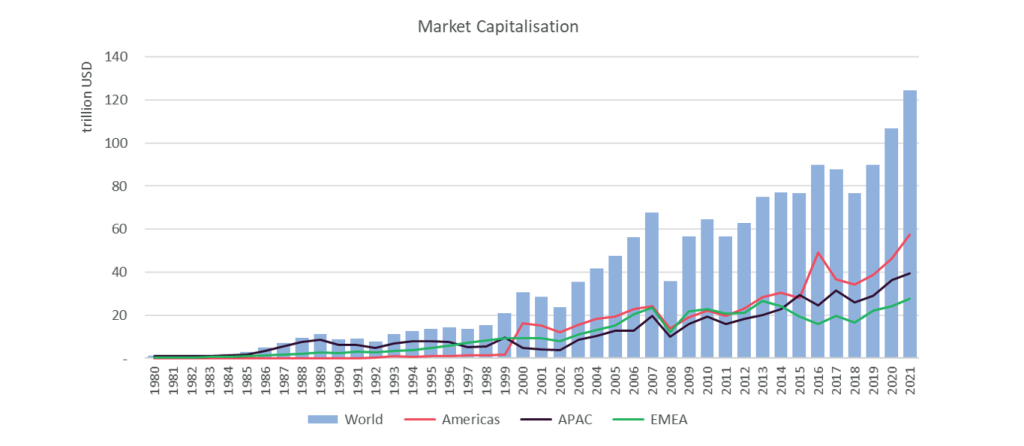
Source: WFE Database. Numbers are not directly comparable because of increases in reporting population.
In the short run shares can be relatively volatile, especially individual shares. But only in the most challenging years does volatility even approach 100% (see Annex 1). Intriguingly, there is some evidence that credit-market conditions temporarily affect share values. It would arguably be strange if share prices were not highly dynamic, since they represent the ever-changing potential of companies and balance of opinion thereon.3
Also, equity investments often do relatively well at recovering after a downturn, in line with the resumption of economic growth. This ability to bounce back has historically been true even of larger falls in asset prices. US shares were recovered within two years of October 1987 – the date of the significant market fall known as Black Monday.4
When it comes to funding, capital markets also accommodate ‘new-economy’ companies, which may not have much in the way of physical assets to post as collateral against loans. Such companies are, in principle, important to digitalisation and to ESG transition, the latter requiring significant funding.5
Two Distinct Types of Channel
Bank lending does have a vital role to play in the economy, especially for SMEs that may not be ready to go down the route of listing. But capital-market financing is relatively under-used in some parts of the world, compared with banking.6
Distinct from loans, bonds have the advantage of being tradable, with a certain amount of investor disclosure, via the prospectus at launch and at least some degree of transactional transparency.7 Caution is, however, also needed in relation to credit more generally. Because all debt needs to be repaid or rolled over, as well as serviced through interest payments, borrowers need to be sure that they have or can quickly raise cash. This differentiates the two types of channel, as equity investors, even though they will naturally demand growth from a company, may differ from creditors in being prepared to forgo short-term income, if the long-term company prospects are good. Equity investment has more capacity to be patient – related to its potential for greater growth. Hence, incentivising SMEs to list is good policy, while letting investment funds take on less liquid positions should, within reason, be accommodated.
The two channels we address in this paper – credit and equity markets – have distinct dynamics and consequences but also an inter-relationship, especially when it comes to risk.
When a market-wide drop in share prices does happen, it appears that it is likely to accompany – and may even be triggered by – an end to easy credit in the financial system more broadly. The latter was true of the events of 2008, when the Dow Jones Industrial Average fell some 7% intraday on 29th September, on news related to the availability of credit bailouts in the US. The elevated stock market volatility around that time came once a multi-year bubble in mortgage finance burst, and triggered a worldwide shock.8 Similarly, in his work on the global October 1987 crash, Robert Shiller notes many investors in the US citing general over-indebtedness as a factor.9 Even when solvency is not in question, illiquidity can affect credit markets and then spread more widely, notably affecting broker dealers, as happened with the collapse of Lehman Brothers.
Even after 30 years of Basel Accords, it is genuinely hard to prevent bubbles and their consequences. There were signs during the Covid 19 period of concern for how the credit system would hold up. Even as equity markets continued to perform, pricing shares and providing a platform for Initial Public Offerings (IPOs),10 there was some debate about whether some financial institutions should be required to retain funds rather than make dividend payments.11 Central banks started supporting corporate debt, to help the wider credit system.12 As the European Supervisory Authorities (i.e., the European Securities & Markets Authority, European Banking Authority and European Insurance & Occupational Pensions Authority) noted in September 2021, “Vulnerabilities in the financial sector are increasing, not least because of side effects of the crisis measures, such as increasing debt levels.”13
A Structural Issue
From a policy perspective, it is important to recognise that the inherent nature of banking is distinct from that of market-based finance. It is hard – maybe even impossible – to rule out runs, given that fractional reserve banking axiomatically entails self-reinforcing dynamics, whereby even the perception that others will withdraw their deposits creates an incentive for all depositors to do so.14
In the capital markets, by contrast, someone selling their investment in a company does not create the same imperative for others to do so. Price moves happen, without triggering an irreversible downward spiral. Moreover, investors can diversify away company specific risk, via collective investment vehicles, and can use derivatives to hedge.
Banking capital requirements cannot eradicate run risk, as failures in early 2023 demonstrate.15 What is present in equity capital markets, by contrast, is price risk.16 Capital-markets investors can ride out a downturn, whereas the whole credit system may seize up when one bank fails, and the effect on the economy can be widespread. In 2009, after such a shock, the whole US economy declined by 2.8%.17
This raises questions about policy proposals relating to so called ‘Non-Bank Financial Intermediation’ – proposals that attempt to treat traded markets as though they presented the same kind of liquidity problem as credit markets. Leaving aside edge cases such as money-market funds, weighing down collective investment schemes with unjustified costs may only compound liquidity issues.
Considering credit channels, all debt appeals to issuers. Part of the attraction to issuers is the fact that inflation erodes the debtor’s burden – the mirror image of shares, which hold their own for investors in the face of inflation. Tax breaks may play a role too, for corporate entities.
But, while such phenomena may be good for issuers of debt, credit channels do always come with the risk that there will be competition for market share, which can create challenges for the wider system. Hence the creation of the Basel Accord.18
The Way Forward
In policy terms, we can conclude that it is justifiable and important to avoid false positives for systemic risk and recognise that equity volatility is a very different type of issue from the structural issues inherent in the credit world.
In a similar vein, it is important to properly assess the nature and role of market-making and asset-management activities. Market intermediaries and proprietary traders help buyers and sellers interact, thereby promoting market capacity, while categorically not being a credit business (credit being an expectation of future cash liquidity).19
More broadly, just as national regimes in many parts of the world rightly encourage individuals’ investment in residential property, the same could work well in relation to investments.
On the issuer side, due consideration can be given to minimising the costs and bureaucracy associated with listing, especially for smaller companies; and to ensure a level playing field with private markets when ESG disclosures are increasing, sometimes only on public issuers and not on privately funded entities. Prospectus requirements and disclosures should be proportionate, in terms of frequency and content (and the use of electronic delivery).
Another issue lies in accounting, particularly the effects of ‘fair value’. Despite the role equity plays in financing real people’s long-term future, rules and regulations around financial markets somehow miss the bigger picture. In some parts of the world, equity finance suffers from a bias in accounting with the result that pension schemes, in particular, are pushed towards bond investments. This supposedly means that they ‘match’ their liabilities, even though the relevant point is that those liabilities will not crystallise until well into the future, making capital growth and dividends the more appropriate hedge.
To suggest that pension schemes should, in effect, be forced to hold debt because it is less volatile, is arguably perverse because the real risk is that of poor returns for those who are going to retire. Debt may not even be consistently less volatile, as the experience of UK asset owners in late 2022 shows, when their ‘liability-driven investment strategies’ proved highly problematic.20
On a related note, there may be scope for imaginative thinking around fund liquidity. If they have not done so already, jurisdictions should consider what scope there is for authorising and incentivising collective investment vehicles that (with due disclosure of the fact to investors) do not offer daily liquidity.
Conclusion
Equity capital markets bring a valuable channel for financing economic activity, in large part because they bring their own positive characteristics. While similar in size to banking, equity capital markets offer a very different experience, both for companies and for investors, in terms of long-term growth and the nature of the related risks. In particular, participating in collective investment in shares is not the same as being one of a number of bank depositors, partly because of the opportunity to diversify away risk but also because the dynamics around the liquidation of holdings are very different.
Market downturns can be a response to – rather than the cause of – credit squeezes and may sometimes be the correction of a credit bubble. Volatility and risk are present in the whole financial system but, even if they can spread from the credit channel to equity markets, they cannot be viewed as uniform, either in their dynamics or their consequences. The freedom to adjust (buy/sell) investment positions is socially valuable, partly because of this difference.
Various policy measures can be and are used to incentivise investment. Impeding access to capital markets, on the other hand, entails a significant risk of limiting growth (for both enterprises and investors) and of limiting the ability of investors to make best long-term use of their assets.
Annex – Returns and risks
Market capitalisation, 2004-2021
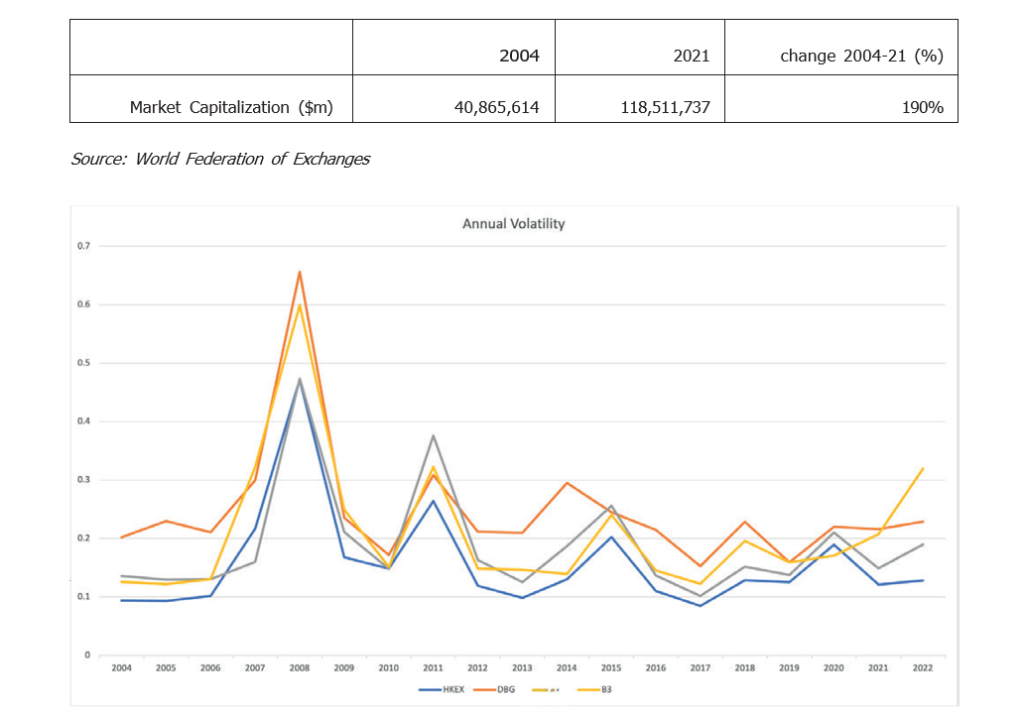
Source: WFE
Footnotes
1 Banking Claims, Bank for International Settlements https://data.bis.org/topics/CBS ; ‘Welcome to the Future of Markets’, World Federation of Exchanges https://www.world-exchanges.org/ accessed 17 September 2024.
2 Statista Research Department, ‘Development of the MSCI World Index from 1986 to 2023’ (Statista, 22 May 2024) https://www.statista.com/statistics/276225/annual-trend-of-the-msci-world-index-since-1969/ accessed 27 June 2024.
3 One should not, however, expect stock-market investors to all simultaneously be gifted with perfect wisdom about the fundamental value of companies. In reality capital markets constantly reprice and a model for price movement lies in the varying distribution of the rational beliefs of agents. See Woody Brock, ‘Resolving the Market Efficiency Paradox’ (Strategic Economic Decisions, Number 125,March 2014), 14 https://www.sedinc.com/fileadmin/user_upload/reports/March_2014/March_2014_SED_PROFILE.pdf).
4 Donald Bernhardt and Marshall Eckblad, ‘Stock Market Crash of 1987’, (Federal Reserve History, November 22 2103) http://www.federalreservehistory.org/essays/stock-market-crash-of-1987#:~:text=Stock%20markets%20quickly%20recovered%20a,surpassed%20their%20pre%2Dcrash%20highs.
5Christian Keller and Maggie O’Neal, ‘Costing the Earth: What will it Take to Make the Green Transition Work’ (World Economic Forum, September 29 2023 https://www.weforum.org/agenda/2023/09/costing-the-earth-how-to-make-green-transitionwork/#:~:text=Estimates%20for%20just%20how%20much,product%20is%20about%20%24100%20trillion.
6 Panagiotis Asimakopoulos, ‘The Future of EU Capital Markets’ (New Financial, September 2021) https://newfinancial.org/thefuture-of-eu-capital-markets/#:~:text=The%20reliance%20on%20banks%3A%20companies,than%20level%20in%20the%20EU27.
7 Bonds also clearly play an important role in finance and in investment portfolios. In particular, someone approaching retirement may want more of their financial assets in fixed income than in shares, as compared with someone just beginning their career.
8 Kimberley Amadeo, ‘The Stock Market Crash of 2008’ (The Balance, updated 8 June 2024) http://www.thebalancemoney.com/stock-market-crash-of-2008-3305535 accessed 27 June 2024.
9 Robert Shiller, ‘Investor Behaviour in the October 1987 Stock Market Crash’ (NBER, Working Paper 2446, November 1987) 10 http://www.nber.org/system/files/working_papers/w2446/w2446.pdf.
10 “When compared with 2019, the number of new listings through IPOs and investment flows through IPOs increased significantly, by 25.7% and 36.8% respectively. There was a 1.1% increase in the number of listed companies.” WFE, ‘2020 Market Highlights’ https://www.world-exchanges.org/our-work/articles/fy-2020-market-highlights accessed 17 September 2024.
11 Sheila Bair, ‘Force Global Banks to Suspend Bonuses and Payouts’ (Financial Times, 22 March 2020) www.ft.com/content/ed87b5d6-6a8e-11ea-a6ac-9122541af204?shareType=nongift
12 ECB www.ecb.europa.eu/mopo/implement/pepp/html/index.en.html accessed 27 June 2024; and Jonnelle Marte, ‘NY Fed to Begin to Sell Corporate Bond Holdings’ (Reuters, 8 July 2021) www.reuters.com/article/markets/us/ny-fed-to-begin-to-sellcorporate-bond-holdings-on-july-12-idUSL2N2OK1EC/
13 ESMA et al, ‘Joint Committee Report on Risks and Vulnerabilities in the EU Financial System’, 2 https://www.esma.europa.eu/sites/default/files/library/jc_2021_45_-_joint_committee_autumn_2021_report_on_risks_and_vulnerabilities.pdf accessed 27 June 2024
14 Royal Swedish Academy of Sciences, ’Financial Intermediation and the Economy’ (Sveriges Riksbank Prize in Economic Sciences in Memory of Alfred Nobel, to Ben Bernanke et al., 10 October 2022) www.nobelprize.org/uploads/2022/10/advancedeconomicsciencesprize2022.pdf accessed 27 June 2024.
15 Edward Helmore, ’Why did the $212bn Tech-Lender Silcon Valley Bank Abruptly Collapse’ (The Guardian, 17 March 2023) https://www.theguardian.com/business/2023/mar/17/why-silicon-valley-bank-collapsed-svb-fail
16 Related counterparty risk is managed through central clearing.
17 Wayne Duggan, ‘A Short History of the Great Recession’ (Forbes, updated 21 June 2023) https://www.forbes.com/advisor/investing/greatrecession/#:~:text=The%20Great%20Recession%20of%202008,down%2057%25%20from%20its%20highs.
18 Bank for International Settlements, ‘History of the Basel Committee’ https://www.bis.org/bcbs/history.htm accessed 17 September 2024. “There was strong recognition within the Committee of the overriding need for a multinational accord to strengthen the stability of the international banking system and to remove a source of competitive inequality arising from differences in national capital requirements.”
19 Con Keating, ‘Completely liquid’ (Futures & OTC World, August 1999).
20 Con Keating and Ian Clacher, ‘The Reframing of the LDI Narrative’ (Professional Pensions, 14 October 2022) www.professionalpensions.com/opinion/4057810/reframing-ldi-narrative-hide-tragedy-db-dc-schemes.
